Two buyers walk up to this counter needing opposite answers. A panel shop has flatted a repair, cleared it, and can now see sanding scratches under the shop lights and holograms once the car sits outside. An owner has found overspray across the bonnet, or fine swirls after a quick wash. The first is a correction job with a known cause and a published order. The second often is not, and that is where money and clear coat get wasted.
The rule underneath both is one two separate manufacturers on our shelf publish independently: decontaminate before you protect. Juice states that clay removes environmental contamination such as iron fallout so wax or sealant can bond, and Finixa says its cleaning clay bar prepares the paint for polishing or waxing. Overspray, bug debris, road tar, rail dust and fresh water spots sit on top of the clear coat, not in it, and Finixa describes its clay bar as non-abrasive. Reach for a compound first and you cut away clear coat to remove something that would have lifted off.
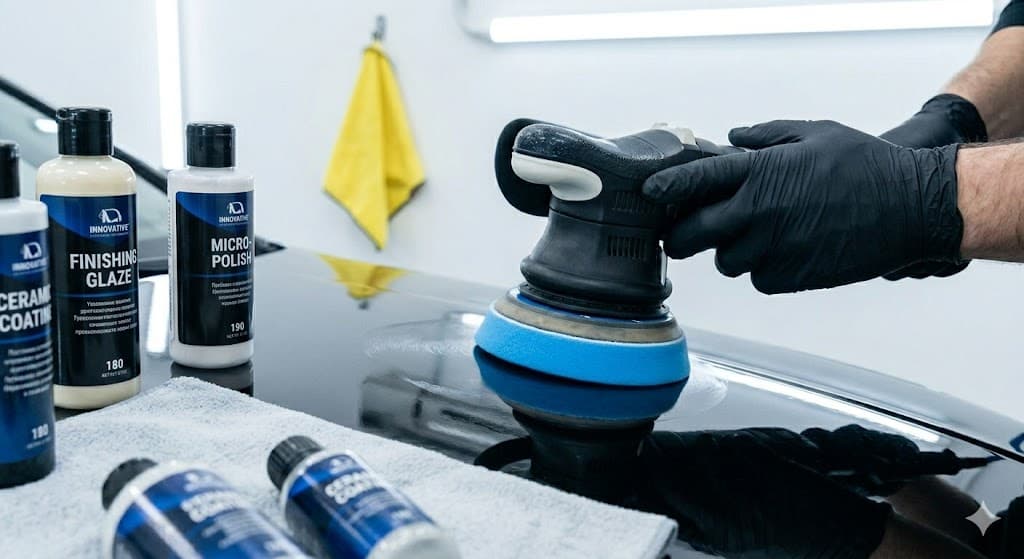
Only after that does cutting make sense, and that order is published too. Juice's directions for NXT Cut run cut, refine, protect: the compound on a wool cutting pad, buffed between 1500 and 1800 rpm until gloss appears, the same compound again on a green sponge pad for a swirl-free finish, then a coat of its sealant. N-Cut Compound is published at 1200 to 1800 rpm and its directions name no pad, so the band to follow is the one printed on the tin in your hand, not one carried across from another product.